Traditional Egyptian Clothing From the Pharaohs to Today
Traditional Egyptian dress displays a remarkable consistency that defies the centuries: more than 3,000 years of history have barely altered its fundamental characteristics. This extraordinary permanence reveals far more than a mere fashion trend; it testifies to the profound wisdom of a people who perfectly understood the art of dressing according to their environment.
1- Clothing in Ancient Egypt-Between Simplicity and Symbolism
The clothing art of Pharaonic Egypt reveals a sophisticated approach to dress that transcends mere functionality. These textile creations embodied a perfect balance between the climatic demands of the desert and the subtle expression of social hierarchies.
The loincloth and the dress are basic clothing items
The shenti remains the emblem of Egyptian masculine elegance. This rectangular piece of linen, artfully knotted around the hips, could be of varying lengths and feature sophisticated pleats depending on the occasion.
Its apparent simplicity concealed a masterful draping technique, allowing men complete freedom of movement while keeping their torsos bare for better protection against the heat. This stylistic evolution also led to the adoption of the lasiris, a loose-fitting tunic that provided additional protection during important ceremonies.
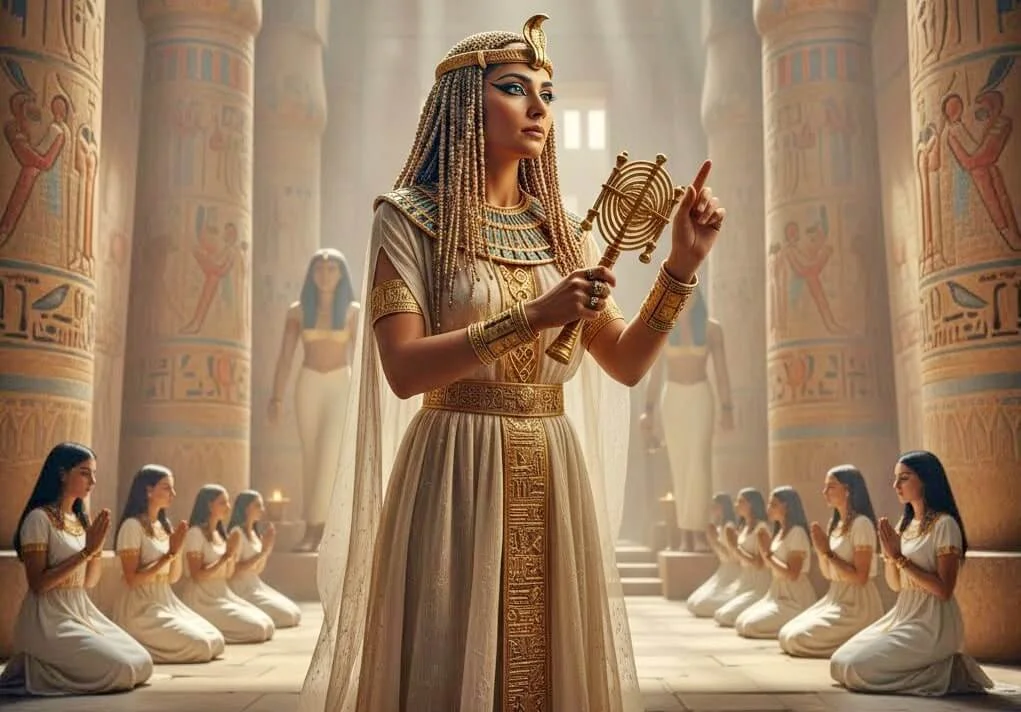
The women’s wardrobe revolved around the sh th dress, a masterpiece of fitted tailoring that harmoniously hugged the body’s curves. This straight garment, held at the shoulders by thin straps, generally reached to the ankles and created a strikingly graceful silhouette.
Its ingenious design ensured optimal ventilation while maintaining modesty. Later periods saw the emergence of semi-transparent variants that revealed the technical mastery of Egyptian weavers.
Differences between social classes
Egyptian social hierarchy was expressed with remarkable sartorial subtlety. Distinctions lie not in the form of the garments, but in their quality of execution and ornamentation:
- The fineness of the fabric was the primary social marker: the finest fabrics, with their delicate transparency, remained the preserve of the ruling classes.
- The complex pleats nd draping required considerable artisanal skill, reserved for aristocratic commissions.
- Embroidery and beading transformed simple garments into wearable works of art, a privilege of the nobles and the royal family.
- The amount of clothing owned directly reflected the economic prosperity of its owner.
The sovereign was distinguished by specific royal attributes: the nemes headdress with its characteristic stripes, the false beard symbolizing divine wisdom, and the chent, the double crown that symbolized his authority over the Two Lands. These elements, enhanced by precious jewels, created an immediately recognizable aura of divine majesty.
Textiles used-linen, leather, papyrus
Linen reigned supreme in the Egyptian textile industry. This exceptional fiber, cultivated in the rich lands of the Delta, possessed remarkable qualities: lightness, absorbency, and natural strength.
Its immaculate white hue carried considerable symbolic weight, evoking the spiritual purity so dear to the Egyptians. Master weavers achieved astonishing levels of perfection, creating fabrics of extraordinary fineness, some with up to 160 threads per square centimeter.
Leather is used in the making of essential accessories: belts, sandals, and protective clothing. Egyptian artisans excelled in working with this material, developing remarkably sophisticated tanning and dyeing techniques.
Papyrus, a more marginal but ingenious material, was occasionally used to make light headdresses or summer sandals.
Accessories-sandals, wigs, necklaces
Sandal represented the ultimate refinement of Egyptian footwear. Woven from papyrus fibers, fashioned from fine leather, or carved from precious woods for the elite, they nevertheless remained luxury items.
Daily life in Egypt was conducted barefoot, with sandals reserved for solemn occasions and important journeys.
Wigs occupied a central position in Pharaonic aesthetics. Made from human hair or carefully worked plant fibers, they served a dual purpose: sun protection and expression of social rank.
These hair creations, often voluminous and skillfully structured, could receive precious ornaments or decorative headbands that enhanced their magnificence.
The jewelry transcended its ornamental function to become true talismans. The usekh necklaces, these wide ornaments that covered the shoulders, the ornate bracelets, a nd the chiseled rings carried a fundamental protective and religious charge.
All social classes sported these ornaments, with materials adapted to their means: gold and precious stones for the aristocracy, colored earthenware and pearls for the working classes.
The Egyptian dynasties offer a fascinating glimpse into the evolution of clothing, where each era brings its own particular nuances while preserving the essence of traditional Egyptian dress. This millennia-long progression reveals how a civilization can refine its creations without ever abandoning its aesthetic foundations.
Old Kingdom-loincloth and form-fitting dress
The Old Kingdom (2686-2181 BC) established the fundamental dress codes that would last for millennia. Men exclusively wore the short, fitted loincloth, a rectangular piece held at the waist by a strip of fabric or leather.
This remarkably understated men’s wardrobe consisted mainly of white, beige, or ecru linen. Only jewelry allowed one to discern social distinctions.
Women of that era adopted a characteristic silhouette: the long, fitted dress perfectly hugged their curves, stopping below the bust and held up by one or two delicate straps.
This cut revealed a subtle social hierarchy: elite women wore longer dresses covering their chests, while those from the lower classes often adopted the same simple loincloth as their male counterparts.
Middle Kingdom-tunic and transparency
The Middle Kingdom (2055-1650 BC) marks the emergence of a certain refinement in clothing. Men enriched their outfits with a second belt layered over the first and adopted loincloths adorned with front pleats.
The ruling classes developed more elaborate clothing, characterized by wide bands of fabric arranged asymmetrically over the right shoulder and under the left shoulder.
Women’s fashion is undergoing a notable transformation towards delicacy and transparency, subtly revealing the body’s shape. These form-fitting dresses are enhanced with sleeves and plunging necklines, often accentuated by necklaces with clasps adorning the throat.
Egypt’s commercial opening encouraged the emergence of new motifs: Cretan marine representations – fish, waves – and symbolic animal motifs now enriched the decorative repertoire.
New Empire-Sophistication and Embroidery
The New Kingdom (1550-1070 BC) represents the pinnacle of Egyptian sartorial refinement. Men abandoned the traditional loincloth in favor of full skirts and pleated shirts. The Amarna period particularly revolutionized masculine conventions, introducing the pleated and transparent tunic worn under a pleated or full loincloth.
This period also revolutionized women’s fashion. Women adopted elegant, long, ea, nd flared dresses, often semi-transparent, which enhanced the beauty of the body.
These creations, despite their apparent simplicity, are distinguished by a pleating art of remarkable sophistication: some radiate “like the sun”, others blossom into large masses of fabric.
Women embellished their clothing with pearls, gold thread, and exquisite embroidery. Religious motifs became more complex, incorporating divine representations, sacred symbols like the Eye of Horus, and detailed mythological scenes.
Influence of the Hyksos and Nubians
The Hyksos, who settled in Egypt around 1782 BC and founded the 15th Dynasty, are surprising in their respect for Egyptian fashion. Admirers of the local culture, they fully adopted Egyptian customs and clothing.
Their contribution nevertheless proved decisive from a technical point of view: the introduction of the vertical loom made it possible to produce superior quality linen.
The New Kingdom period also saw the emergence of Nubian influence in certain decorative motifs, without, however, altering the fundamental style of dress. These cultural exchanges gradually enriched the ornamental repertoire without disrupting established structures.
This dynastic progression reveals how traditional Egyptian dress evolved towards greater refinement and complexity, while preserving its essential characteristics of simplicity and functionality. This evolution faithfully reflects the social, economic, and cultural transformations that shaped this ancient civilization.